SEO Software Review
Semrush Review: Features, Strengths, Limitations and Who It’s For
A research-based Semrush review covering keyword research, competitor analysis, site audits, rank tracking, reporting, tradeoffs, and business fit.
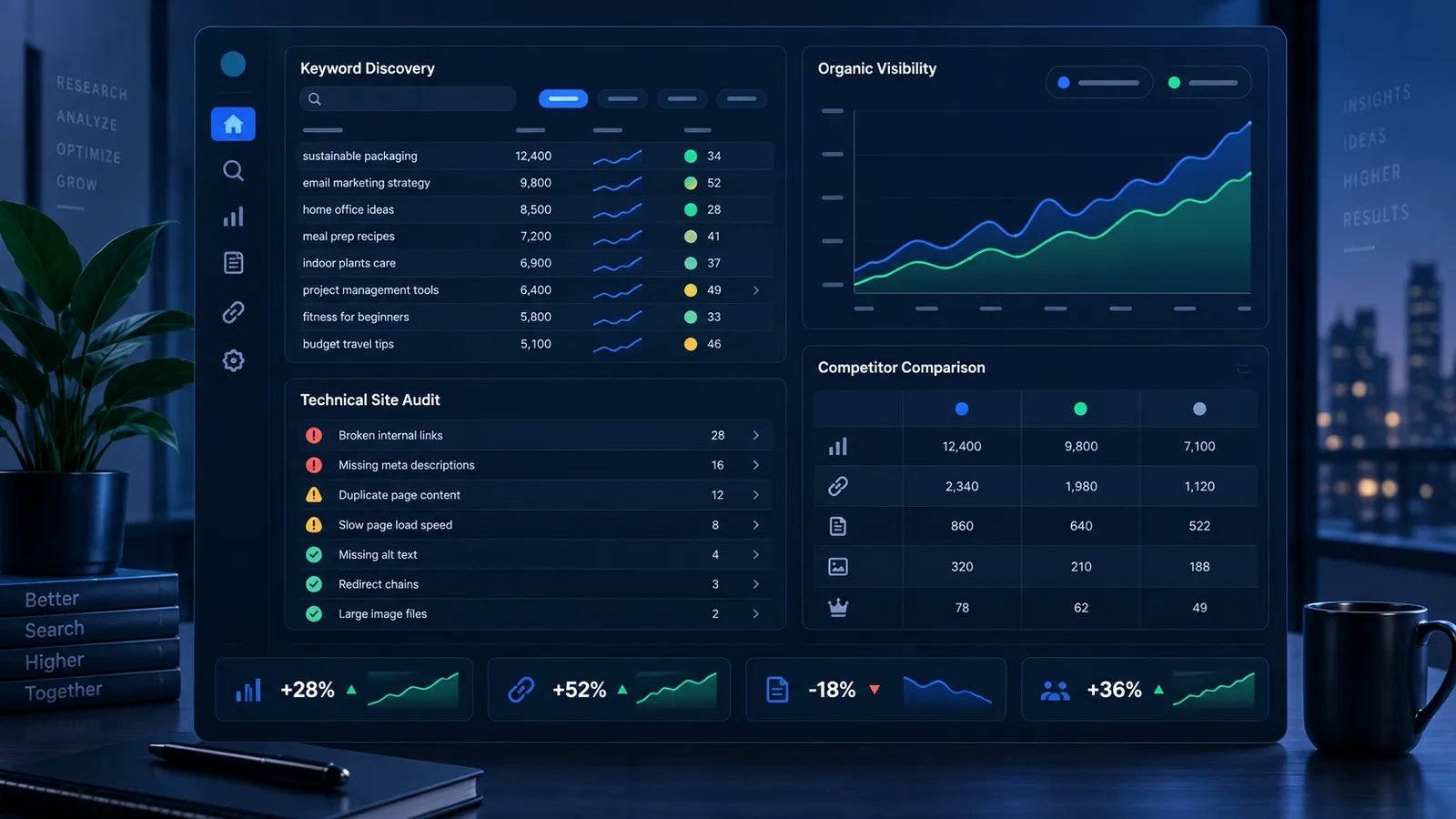
Semrush is a broad SEO and digital-marketing platform with tools for keyword research, competitive analysis, technical auditing, position tracking, and reporting. This review is based on publicly available product documentation and product materials; it is not a claim of hands-on testing or a guarantee of outcomes.
Quick overview
| Area | What to evaluate |
|---|---|
| Core workflow | Research, technical monitoring, rank tracking, and reporting in one platform |
| Strong fit | Teams that need several SEO workflows connected in one workspace |
| May be more than needed | Small sites with a simple Search Console-led process |
| Pricing | Check current pricing directly with Semrush |
Who Semrush may be for
Semrush may suit in-house marketing teams, SEO specialists, agencies, and businesses that regularly research new topics, monitor competitors, audit websites, and report on recurring work. The value proposition is breadth: a team can move between research, projects, tracking, and reporting without stitching together many separate tools.
Who may not need Semrush
A new local business with a small site and a limited SEO workflow may be better served by Google Search Console, a clear content process, and a lighter research tool. A subscription is harder to justify when the team does not have time to act on the data already available.
Keyword and competitor research
Semrush’s Keyword Overview provides keyword metrics, intent, SERP analysis, and bulk analysis options. Its documentation also describes sending selected terms into a keyword-planning workflow. That can be useful when research moves from one query to a prioritized list of pages or topics. See Semrush’s Keyword Overview documentation for the current feature set and limits.
For competitor research, treat estimated third-party data as directional. It can help generate hypotheses about topics, pages, and search competitors, but it should not replace customer research or first-party performance data.
Site auditing and rank tracking
Semrush Site Audit crawls a configured domain, subdomain, or subfolder and surfaces technical issues for review. Scope matters: a crawl is only as useful as the pages and settings included. Position Tracking can monitor a chosen set of keywords by location and device, which is more useful for a defined SEO program than for broad discovery alone.
Reporting and workflow
Reporting can matter as much as the data for agencies and cross-functional teams. Semrush documents connections for Looker Studio with Domain Analytics, Position Tracking, and Site Audit data. Confirm current connectors, permissions, and plan limits during a trial if reporting is central to your process.
Ease of use
The same breadth that helps a mature team can create a learning curve. Build a short recurring workflow before buying: which reports will be checked, by whom, how often, and what action follows? A platform is easier to use when the team has a defined job for it.
Strengths
- Broad coverage across research, technical auditing, tracking, and reporting.
- Project-based workflows that can support ongoing SEO programs.
- Location and device options for tracked keywords.
- Useful fit for teams that need to connect research to reporting.
Limitations and pricing considerations
Semrush is not a substitute for implementation, editorial judgment, or measurement of business outcomes. Pricing, usage limits, projects, users, and data access can change, so compare the plan you would actually use—not only the entry tier. Verify current details on the official pricing page before purchasing.
Semrush alternatives
Ahrefs is commonly evaluated alongside Semrush for search, content, and backlink research. Ubersuggest may be worth considering for businesses that need a lighter workflow. Read our Semrush vs Ahrefs comparison and keyword research guide for scenario-based context.
Final considerations
Semrush may be a strong fit when breadth and recurring workflow matter more than a single specialized feature. Run a trial against real tasks: research a service topic, inspect a technical issue, configure a tracking set, and create a report someone else can understand.
FAQ
Does Semrush guarantee rankings or traffic?
No software platform can guarantee rankings, traffic, ROI, or revenue. Tools provide data and workflows; results depend on execution, competition, site quality, and search systems.
Is Semrush appropriate for small businesses?
It can be, if the business has a recurring SEO process and uses enough of the workflow to justify the plan. A simpler stack may be more appropriate for an early-stage site.
Methodology and affiliate disclosure
This page compares documented capabilities, workflow fit, limitations, and pricing considerations. We do not accept payment for a positive conclusion. Software Scout Lab may earn commissions from qualifying links in the future; see our Affiliate Disclosure. Any affiliate relationship should be disclosed near the relevant link.